


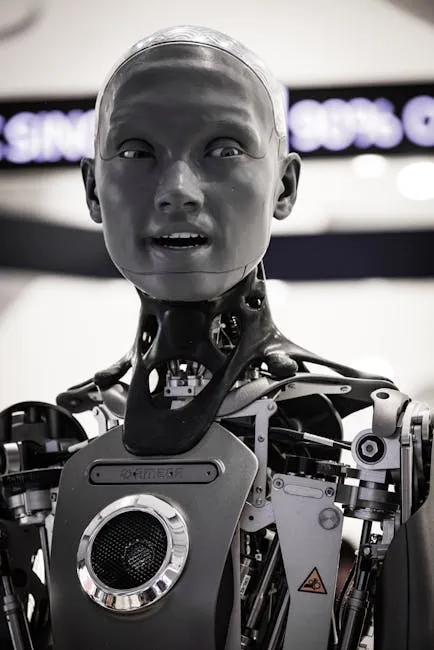
The robotics world is moving fast. We are past the days of clunky prototypes and into an era where machines are starting to look, move, and think more like us. One idea driving this shift is a kind of hybrid approach. As Spencer Huang, Nvidia’s robotics lead, points out, the next generation of humanoid robots is being built by combining two distinct ecosystems: a highly engineered Chinese chassis and a cutting-edge American AI brain.
The anatomy of a next-generation humanoid
When developers talk about a robot having a “Chinese body” and an “American brain,” they mean a strategic split that plays to each region’s strengths. On the hardware side, companies like Unitree have been pushing mechanical engineering forward. Their H2 Plus model stands about six feet tall and is built for endurance, agility, and real-world use. Chinese manufacturers have spent years refining high-torque actuators, lightweight composite materials, and efficient power systems. The result is a physical platform that can handle uneven terrain, lift heavy weights, and run for long periods without overheating or dying.
Engineering for real-world performance
Hardware alone does not make a functional humanoid. A robot that can stand and walk is useless if it cannot understand its environment or make quick decisions. This is where software becomes the real differentiator. Nvidia has positioned itself as the backbone of physical AI, building the computational frameworks that let robots process visual data, predict outcomes, and adapt to unexpected situations. By using Nvidia’s Isaac platform and advanced neural processing units, developers can give these machines the cognitive flexibility needed for complex tasks.
Why this collaboration matters
The combination of American AI infrastructure with Chinese hardware manufacturing is more than a technical achievement. It signals that the robotics industry is growing up. For years, the sector struggled with the gap between lab research and real-world products. Robots were either too expensive, too fragile, or too dumb to function outside controlled environments. By using Unitree’s cost-effective, industrial-grade hardware alongside Nvidia’s scalable AI simulation tools, developers can now iterate faster and test more safely. Digital twins and physics-based simulations let engineers train robots in thousands of virtual scenarios before they ever take a physical step.
This synergy is already showing promise in a few key areas. In manufacturing and logistics, humanoids can assist in warehouses and assembly lines, handling repetitive lifting and navigating dynamic factory floors alongside human workers. In construction and inspection, the ability to climb stairs, move over debris, and process visual data in real time makes these robots useful for hazardous site inspections. And in healthcare and elderly support, robust humanoids could provide physical assistance, from lifting patients to fetching supplies, without the rigid limits of traditional devices.
Challenges on the road to deployment
Despite the rapid progress, there are still real hurdles. Power management remains a major bottleneck. Even with efficient actuators, keeping a six-foot humanoid running for a full workday requires serious battery density. Dexterity is another weak spot. These machines can walk and run, but manipulating small objects or doing delicate tasks still lags behind human ability. And the geopolitical climate around technology exports and semiconductor restrictions adds complexity to international hardware-software partnerships. Navigating regulations and ensuring ethical deployment will be just as important as the engineering.
Looking ahead
The idea of a humanoid robot that blends mechanical precision with cognitive intelligence is not science fiction anymore. It is an active development pipeline driven by cross-border collaboration and constant iteration. As Huang suggests, the future of robotics will not be dominated by a single country or company. It will be defined by how well different technological ecosystems can integrate their strengths. When American AI brains are paired with robust, globally engineered hardware, you get machines that are not just technically impressive but practically useful. The next decade will likely see these hybrids move out of research labs and into workplaces, warehouses, and homes, changing how we interact with the physical world.
