


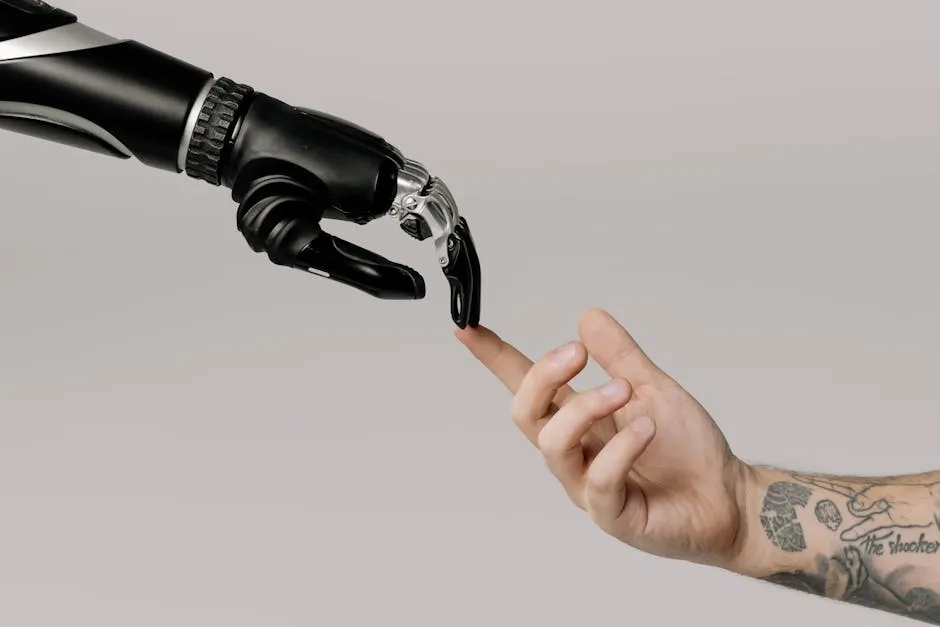
The world of artificial intelligence has long been a realm of pure logic and code, existing within the sterile confines of servers and data centers. But a fascinating new frontier is emerging, one where the lines between the digital and the physical are becoming increasingly blurred. We are moving beyond AI as a simple software tool and into an era where AI agents can interact with, understand, and even control the physical world. A recent experiment involving an AI agent named OpenClaw perfectly illustrates this shift, demonstrating that the coding skills of modern AI models are about to make building and deploying robots dramatically easier.
The Leap from Software to Hardware
For years, the development of robotics has been a painstaking, highly specialized craft. It required deep expertise in mechanical engineering, electrical engineering, and low-level programming. Building a robot that could perform even a simple task like picking up an object was a monumental undertaking, often taking teams of engineers months or years to perfect.
This is where the new wave of AI is changing the game. The core idea is simple yet profound: if an AI model can write sophisticated software code, why can’t it write the code that controls a physical machine? The experiment with the OpenClaw agent is a powerful proof-of-concept. Instead of a human engineer meticulously writing every line of motor control and sensor logic, an advanced AI model was tasked with doing it. The result was an AI agent that could not only think but could also act.
What is the OpenClaw Agent?
The OpenClaw agent is not a physical robot you can buy in a store. It is an AI agent—a sophisticated language model—that was given a unique mission: to inhabit a physical body. In this case, the “body” was a simple, claw-like robotic gripper. The true innovation wasn’t in the hardware, which was relatively basic, but in the software. The AI had to learn how to translate its high-level instructions (like “pick up the red block”) into the precise, low-level commands needed to move the claw’s motors and interpret feedback from its sensors.
This is a monumental leap from generating text or images. It requires the AI to understand spatial reasoning, force, torque, and real-world physics. It’s one thing for an AI to describe how to pick up a cup; it’s a completely different challenge to actually calculate the exact pressure required to grip it without crushing it.
Vibe Coding and the Democratization of Robotics
The term “vibe coding” has started to circulate in tech circles, describing a new way of interacting with computers where you don’t write code line-by-line. Instead, you describe what you want in natural language, and the AI writes the code for you. This concept is now extending into the physical world. Instead of “vibe coding” a website, you can now “vibe code” a robot’s behavior.
This democratization is perhaps the most significant implication. In the past, if you had a great idea for a robot that could help with a specific task—like sorting recyclables in your garage or watering plants on your balcony—you were likely out of luck unless you had a PhD in robotics. Now, you might simply need to be able to clearly articulate your idea to a sufficiently advanced AI.
The AI can handle the heavy lifting: writing the control loops, handling sensor data, and even debugging the inevitable errors that occur when software meets the messy, unpredictable real world. This dramatically lowers the barrier to entry, opening up the field of robotics to a much wider range of inventors, entrepreneurs, and tinkerers.
The Future of Physical AI
This experiment is more than just a cool tech demo. It is a glimpse into a future where AI agents are not just our digital assistants but our physical collaborators. Imagine a construction site where an AI-powered drone and a robotic arm work in tandem, directed by a single human manager who simply tells them, “Move those steel beams over there.” Or a warehouse where a fleet of robots can be instantly retrained to handle a new type of product without a single line of code being written by a human.
This convergence of AI coding and robotics is poised to accelerate innovation in countless industries. Manufacturing, logistics, healthcare, and even home assistance will be transformed. The robots of the future will not be pre-programged with rigid instructions; they will be adaptable, learning, and capable of understanding and executing tasks they have never seen before.
Challenges on the Horizon
Of course, this future is not without its challenges. Safety is the most paramount concern. An AI that writes its own control code could potentially create behaviors that are unpredictable or dangerous. Ensuring that these systems are robust, fail-safe, and aligned with human intentions is a critical area of research. We need to be able to trust that a robot directed by an AI will not accidentally hurt someone.
There are also questions about reliability. The physical world is full of edge cases—a slippery floor, a slightly misaligned object, a sudden gust of wind. Can an AI-generated control system handle these unexpected situations as well as a system meticulously crafted by a human expert? Initial results are promising, but there is still a long way to go.
Conclusion: A New Era of Embodied Intelligence
The story of the OpenClaw agent getting a physical body is a powerful metaphor for the next great leap in artificial intelligence. We are moving from disembodied intelligence—minds without bodies—to embodied intelligence, where AI can perceive, interact with, and change the physical world. The coding skills of AI models are not just making software development faster; they are building the bridge between the digital realm of ideas and the tangible world of action. The robots of tomorrow are being written into existence today, one line of AI-generated code at a time. This is not just an evolution of technology; it is the beginning of a new partnership between human creativity and machine capability, a partnership that will reshape our physical reality in ways we are only just beginning to imagine.
