


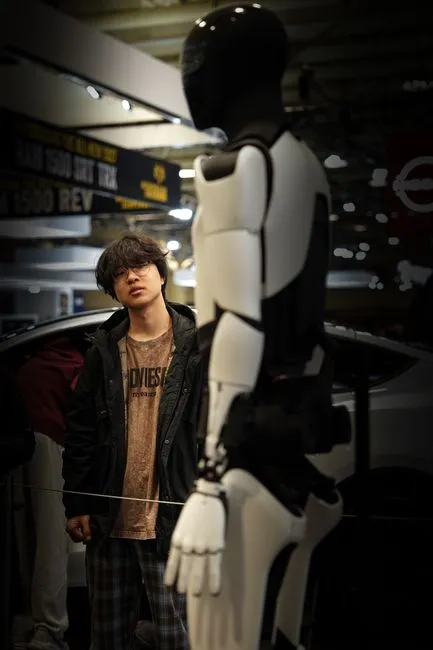
Stepping Into the Machine: The Rise of Humanoid Robot Operators
Step inside a high-tech laboratory in Shenzhen, and you might feel like you have accidentally walked onto the set of Ready Player One. But instead of gaming for virtual credits, a new breed of worker is suiting up in full-body motion capture rigs to teach humanoid robots how to move, grasp, and navigate the physical world. At innovative companies like IO-AI Tech, this isn’t just a futuristic experiment—it is a booming career path. As China’s hardware capital races to perfect autonomous machines, human operators are becoming the essential bridge between complex code and physical reality.
The Reality Behind the VR Rig
The concept of teleoperating robots isn’t entirely new, but the scale and sophistication have shifted dramatically in recent years. Modern humanoid robots require massive amounts of real-world movement data to learn balance, dexterity, and environmental awareness. Instead of relying solely on computer simulations, developers are turning to actual humans wearing sensor-laden suits. These operators perform everyday tasks like picking up objects, walking over uneven terrain, or manipulating delicate tools, while their movements are recorded, translated, and fed directly into the robot’s neural networks. It is a hands-on approach to artificial intelligence training that prioritizes real-world physics over virtual approximations.
How the Motion Capture System Works
The technology behind these setups is remarkably immersive. Operators don a specialized exosuit or motion-capture rig equipped with inertial measurement units, joint sensors, and sometimes haptic feedback systems. As they move, the suit translates their biomechanics into digital signals that the robot mirrors in real time or uses for later training. The goal isn’t just to make the machine copy a human exactly, but to capture the subtle nuances of human movement—weight shifts, grip adjustments, and spatial reasoning—that are incredibly difficult to program from scratch. Over time, machine learning algorithms refine these inputs, allowing the robot to eventually operate independently.
Why Shenzhen Is the Epicenter of Physical AI
Shenzhen has long been known as the world’s factory for consumer electronics, but its role is rapidly evolving. The city’s dense network of hardware suppliers, rapid prototyping workshops, and agile engineering talent makes it the perfect testing ground for next-generation robotics. Companies like IO-AI Tech are tapping into this ecosystem to iterate quickly. When a sensor fails or a joint mechanism needs tweaking, engineers can source parts and test prototypes within days, not months. This infrastructure, combined with strong government support for advanced manufacturing, has created a hot job market for robot trainers, data annotators, and AI testers. The demand for workers who can translate human intuition into machine learning is higher than ever.
The Human Element in Autonomous Development
There is a common misconception that artificial intelligence development is purely a software game played out on servers and screens. The reality is that physical AI requires a heavy human footprint. Training humanoid robots is physically demanding and requires patience, spatial awareness, and a keen eye for detail. Operators often work long shifts, repeating the same motions dozens of times to ensure the AI learns correctly. This work highlights a crucial truth: even as machines become more autonomous, human intuition and physical experience remain irreplaceable in the early stages of development. The data these workers generate becomes the foundation for everything from warehouse automation to medical assistance robots.
What This Means for the Future of Work
The rise of robot trainers points to a broader shift in the tech labor market. As companies race to deploy humanoids in industrial settings, the demand for specialized training roles will only grow. These jobs sit at the intersection of athletics, technology, and data science. They also raise interesting questions about workforce development. Will vocational schools start offering motion-capture certification? Will backgrounds in gaming, simulation, or physical therapy become valuable assets in robotics? The answers are still forming, but one thing is clear: the future of hardware isn’t just being coded—it is being performed.
Stepping into a motion-capture suit to train a humanoid robot might sound like science fiction, but in Shenzhen, it is just another day at the office. As artificial intelligence continues to blur the lines between digital and physical, human operators are proving that some lessons can only be taught through direct experience. The machines may eventually walk on their own, but for now, they are learning to move by watching us. This symbiotic relationship between human trainers and silicon brains is not just accelerating robotics—it is redefining what it means to work in the age of automation.
