


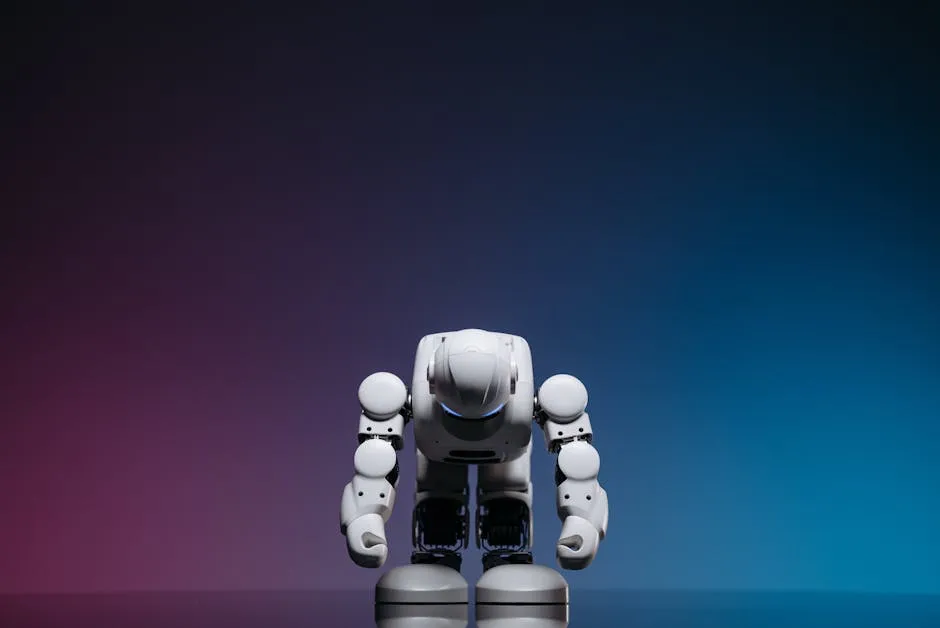
The line between the digital and physical worlds is becoming increasingly blurred. We’ve all seen what AI can do in the realm of code, generating text, images, and even software. But what happens when you give that same coding intelligence a physical body? The answer, as it turns out, is a new era for robotics—one that might be far more accessible than you ever imagined.
A recent experiment involving an AI agent called OpenClaw demonstrated this leap perfectly. By attaching its powerful coding capabilities to a physical robot chassis, the project showcased a future where building and deploying robots could become as straightforward as writing a software prompt. This isn’t just about making cooler gadgets; it’s a fundamental shift in how we approach automation, manufacturing, and even our daily chores.
The OpenClaw Experiment: A Case Study in Physical AI
The core idea behind the OpenClaw project was simple yet profound: take an AI model that is exceptionally good at writing code and give it the ability to control hardware. The agent wasn’t just a pre-programmed set of instructions. It was an adaptive intelligence that could interpret its environment, write new code on the fly to solve problems, and physically interact with the world around it.
Think of it as the difference between a player piano and a jazz musician. The player piano can play a perfect rendition of a song, but it cannot improvise. The AI agent, like the jazz musician, can read the room, adapt to a new key, and compose a new melody on the spot. In the context of robotics, this means a robot that can fix its own errors, navigate unexpected obstacles, and learn new physical tasks without requiring a team of software engineers to rewrite its firmware.
Why This Matters: Lowering the Barrier to Entry
For decades, robotics has been the domain of specialists. You needed expertise in mechanical engineering, electrical engineering, and low-level programming to build a functional robot. The cost of entry was high, both in terms of money and education.
The integration of advanced AI coding agents like the one used in OpenClaw changes this equation entirely. If an AI can write the control code for a robot, the human role shifts from “programmer” to “director.” You don’t need to know the syntax for controlling a servo motor or the algorithm for pathfinding. You simply need to describe what you want the robot to do.
“Pick up the blue block and place it in the red bin,” becomes a viable instruction. The AI translates that natural language command into the precise, step-by-step code required to execute the action. This democratization of robotics could unlock a wave of innovation from hobbyists, small businesses, and industries that previously couldn’t justify the investment in a robotics team.
The “Vibe Coding” Era Comes to Hardware
This trend aligns perfectly with the concept of “vibe coding,” a term that has gained traction in the AI community. It describes a style of programming where you don’t worry about the syntax or the nitty-gritty details. You just have an idea (a “vibe”), and you let the AI handle the implementation.
We saw this first in software. People with no coding experience could build apps and websites by simply describing them. Now, that same power is being extended to the physical world. You can have a “vibe” for a robot that waters your plants or sorts your recycling, and an AI agent like OpenClaw can figure out the mechanics and the code to make it happen.
This is not science fiction. The experiment demonstrated that an AI could write the code to control a robotic arm, adapting its approach when the initial code didn’t work perfectly. It could debug its own errors, test new solutions, and iterate until the physical action was successful. This iterative, trial-and-error process, which is the bane of traditional robotics, becomes a core strength of AI-driven development.
Implications for the Future of Work and Industry
The implications of this technology are vast. We are moving towards a world where custom robots can be designed and deployed as quickly as a software update.
Manufacturing and Logistics
Factories could adapt their assembly lines overnight. Instead of shutting down production for weeks to re-tool for a new product, a manager could simply tell the AI to reconfigure the robots. “We’re switching from making toasters to making kettles. Please adjust the grip strength and assembly sequence.” The AI would handle the code, and the robots would be ready by morning.
Home and Personal Use
Imagine a robot that you buy off the shelf. It can’t do much at first, but it can learn. You tell it, “Please learn how to fold laundry,” and it watches you, or reads a manual, or runs a simulation, and then writes the code to do it. This is the ultimate smart home device—one that is not limited by its pre-installed software but is limited only by your imagination and its physical capabilities.
Disaster Response and Exploration
In dangerous environments, we could deploy a general-purpose robot and let an AI agent figure out how to navigate the rubble or open a specific type of door. The robot wouldn’t need a pre-programmed solution for every possible scenario. It would have the intelligence to adapt and solve problems in real-time, saving lives and exploring places humans cannot reach.
The Challenges Ahead
Of course, this future is not without its challenges. Safety is the primary concern. An AI that can write its own code to control a physical body could make a mistake that has real-world consequences. A software bug is annoying; a robot bug that causes it to swing a heavy arm into a person is dangerous. Robust safety protocols, hardware-level kill switches, and extensive simulation testing will be critical.
There is also the question of reliability. Can we trust an AI to write flawless code for a safety-critical system? The current models are impressive, but they are not perfect. They can hallucinate, misunderstand instructions, or write code that works 99% of the time but fails catastrophically on the 1% edge case.
Finally, there is the cost of the hardware itself. While the software side is becoming cheaper and more accessible, the motors, sensors, and chassis of a robot still cost money. The OpenClaw experiment was a proof of concept, but building a durable, useful robot for the home or factory still requires a significant hardware investment.
A New Kind of Engineer
Despite these challenges, the trend is clear. The skills required to build robots are changing. The future engineer might not be a master of C++ or ROS (Robot Operating System). Instead, they will be a master of prompting and system design. They will know how to frame a problem for an AI, how to verify the AI’s output, and how to integrate the final product into a physical system.
This is not the end of engineering; it is an evolution. It allows the human mind to focus on the “what” and the “why,” while the AI handles the “how.” This synergy between human creativity and machine precision is where the most exciting innovations will come from.
Conclusion
Giving an AI coding agent a physical body is more than a neat party trick. It is a glimpse into a future where robotics is no longer a specialized, inaccessible field. The OpenClaw experiment proves that we are on the cusp of a revolution where anyone with a good idea and a bit of hardware can build a robot. The age of the general-purpose, adaptable robot is not just coming; it is being coded into existence, one prompt at a time. The question is no longer “Can we build it?” but “What will we ask it to do?”
