


Autonomous transportation is no longer a futuristic idea reserved for science fiction films. It is becoming a practical reality, powered by artificial intelligence, improved sensors, edge computing, and smarter data systems. From driverless cars and autonomous buses to sidewalk delivery robots, AI is quietly reshaping how people and goods move through cities, suburbs, and industrial zones.
The core promise of autonomous transportation is simple: reduce the need for human drivers in routine, predictable, or repetitive movement tasks while improving safety, efficiency, and access. In practice, that promise is much more complex. A self-driving vehicle must interpret the world in real time, anticipate the behavior of other road users, make split-second decisions, and operate reliably in conditions that can change without warning. That is where AI becomes essential.
How AI Powers Autonomous Transportation
At the heart of every autonomous vehicle is a stack of AI systems working together. These systems handle perception, prediction, planning, and control.
Perception: Understanding the Environment
Self-driving systems rely on a combination of cameras, radar, and lidar to build a detailed picture of their surroundings. AI models analyze this sensor data to identify cars, pedestrians, cyclists, traffic signs, lane markings, obstacles, and road conditions. The challenge is not just detection, but interpretation. A vehicle must know whether a person is about to cross the street, whether another driver is about to turn, or whether a pile of debris is blocking a lane.
Prediction: Anticipating What Happens Next
Transportation is full of uncertainty. Pedestrians move unpredictably, other drivers make imperfect decisions, and weather can change quickly. AI helps autonomous systems predict likely future behavior by analyzing patterns from past data and real-time observations. This predictive layer is critical because a vehicle does not just need to react to the present; it needs to prepare for what may happen in the next few seconds.
Planning and Control: Making Safe Decisions
Once the system understands its environment and predicts how it may change, it must decide how to act. Should the vehicle slow down, change lanes, stop, or continue? AI-driven planning algorithms weigh safety, efficiency, legal rules, and comfort to generate a smooth and appropriate driving path. The control layer then translates that plan into precise steering, acceleration, and braking commands.
Driverless Cars and the Road Ahead
Driverless cars are the most visible symbol of autonomous transportation. They represent a major shift in personal mobility, potentially reducing traffic accidents caused by human error, improving mobility for people who cannot drive, and changing how cities are designed.
However, the path to widespread adoption is not straightforward. Autonomous cars must perform reliably in rain, fog, low light, construction zones, and densely populated areas. They must also handle rare and unusual situations, often called edge cases, that are difficult to predict during testing. Public trust is another major factor. People must feel confident that a driverless vehicle is safe, responsive, and capable of handling the unexpected.
Robotaxis and Shared Mobility
One of the most promising applications of autonomous driving is the robotaxi. Instead of owning a car, people could summon a driverless vehicle when needed, potentially reducing congestion and lowering transportation costs in urban areas. For cities, this could also mean less demand for parking spaces, which could be converted into parks, housing, or public plazas.
Autonomous Buses and Public Transit
While passenger cars attract the most attention, autonomous buses may be one of the most practical near-term applications. Buses often operate on fixed routes, making them easier to map, test, and regulate than fully autonomous cars navigating open road networks.
AI-driven transit systems can help make public transportation more frequent, punctual, and accessible. An autonomous shuttle could run late into the night, connect neighborhoods to transit hubs, or serve areas where hiring drivers is costly or difficult. For public agencies, the appeal is clear: better service with lower operating costs over time, assuming the technology proves reliable and scalable.
Smart Delivery Robots and Last-Mile Logistics
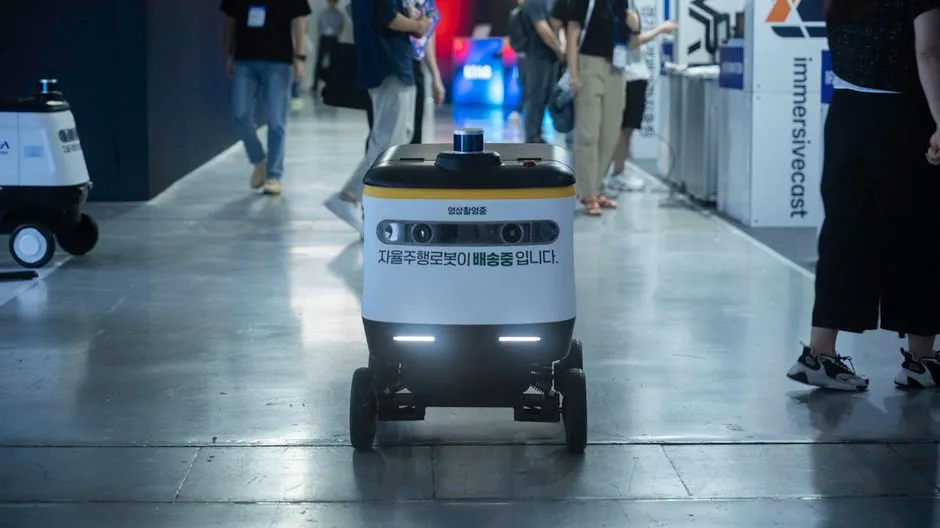
Autonomous transportation is not limited to moving people. One of the fastest-growing areas is last-mile delivery. Sidewalk robots, autonomous vans, and drones are being tested to deliver packages, groceries, medical supplies, and other goods with less dependence on human drivers.
These systems use AI to navigate sidewalks, avoid pedestrians, follow traffic rules, and optimize delivery routes. For businesses, the benefits are significant. Faster delivery, reduced labor costs, and 24/7 operation are all possible in the right environments. For consumers, the appeal is convenience: receiving packages without waiting at home or dealing with missed delivery times.
Still, delivery robots face their own challenges. Sidewalk design, pedestrian safety, weather, local regulations, and public acceptance all matter. A small robot may be efficient in a planned area, but it can become disruptive in a busy downtown environment if not properly managed.
The Role of Infrastructure and Data
Autonomous transportation does not exist in a vacuum. It depends on infrastructure, connectivity, and data. Roads need clear markings. Cities may need better signage, dedicated lanes, and curb design that supports autonomous vehicles. Communication technologies such as vehicle-to-everything, or V2X, can allow vehicles to exchange information with traffic signals, other cars, and roadside systems.
Data is equally important. AI systems improve when they are trained on large, diverse datasets that include real-world driving conditions, rare events, and different geographic environments. Simulation tools also play a key role, allowing developers to test thousands of scenarios safely before a vehicle ever reaches the road.
Safety, Regulation, and Public Trust
Perhaps the biggest barrier to adoption is not technology alone, but trust. Autonomous transportation systems must meet high safety standards, and regulators will need clear rules for testing, deployment, liability, and insurance. If an autonomous vehicle is involved in a crash, questions about responsibility become complicated. Who is accountable: the manufacturer, the software developer, the fleet operator, or the passenger?
Privacy is another concern. Vehicles collect large amounts of data about the environment and, in some cases, people. If that data is not handled responsibly, it can raise serious ethical and security issues. Cybersecurity is also critical, because connected vehicles are potential targets for malicious attacks. A breach could affect not only one vehicle, but an entire fleet or even a city’s transportation network.
What the Future Looks Like
The future of transportation will likely be a mix of human-driven and autonomous systems, at least for the foreseeable future. Fully autonomous travel may expand first in controlled environments, such as campuses, airports, industrial sites, and fixed-route transit corridors. Over time, more complex urban and suburban operations may follow as the technology matures and regulations become clearer.
If successful, AI-powered autonomous transportation could reduce traffic accidents, improve access for older adults and people with disabilities, lower emissions through more efficient driving, and reshape urban planning. It could also create new industries, new job categories, and new ways of thinking about mobility as a service rather than ownership.
The key question is not whether AI will change transportation, but how quickly and responsibly that change will happen. The vehicles, robots, and systems being tested today are early steps in a much larger transformation. If developers, regulators, and communities work together to address safety, ethics, and public trust, autonomous transportation could become one of the defining innovations of the next decade. In the end, the goal is not simply to replace human drivers, but to create a transportation system that is safer, more efficient, and more accessible for everyone.
Related read: The AI Race Is Moving Beyond Models: Chips, Infrastructure, and Trust Are Now the Real Contest
