


There was a time when autonomous transportation felt like something out of science fiction. Self-driving cars appearing on glossy magazine covers, robot taxis gliding through city streets, and delivery bots quietly moving packages to doorsteps all seemed like distant promises. Today, artificial intelligence has moved that future much closer to reality. From driverless cars and autonomous buses to smart delivery robots, AI is reshaping how people and goods move through cities, highways, and neighborhoods.
The shift is not just about replacing human drivers. It is about rethinking transportation itself. AI-powered systems can perceive the world, make decisions in split seconds, and adapt to changing conditions in ways that challenge traditional ideas of travel, logistics, and urban planning. As these technologies mature, they are beginning to influence everything from public transit to freight delivery, and from emergency response to everyday commuting.
Why AI Is the Core of Autonomous Transportation
At its center, autonomous transportation depends on machines that can understand complex environments. A vehicle on the road must not only see other cars, pedestrians, cyclists, and traffic signals, but also predict what they may do next. A pedestrian might step off a curb. A delivery truck could change lanes. A child might chase a ball into the street. These are not simple problems.
Artificial intelligence helps solve them by combining sensors, computer vision, machine learning, and decision-making algorithms. Cameras, radar, and lidar collect data about the surrounding environment, while AI models interpret that data and generate responses. In many ways, autonomous transportation is one of the most demanding applications of AI because it must operate safely in real time, with very little room for error.
Driverless Cars: From Demonstrations to Real-World Services
Driverless cars have become one of the most visible symbols of AI in transportation. For years, self-driving vehicles were tested on controlled routes, often with safety drivers behind the wheel. Now, the conversation has shifted toward scaled services, fleet operations, and commercial deployment.
The appeal is easy to understand. Human drivers can be distracted, tired, or inconsistent. AI systems can monitor the road continuously, reduce certain types of accidents, and potentially make travel more efficient. They can also help people who cannot drive, including older adults, people with disabilities, and communities with limited access to public transportation.
However, driverless cars are still navigating major challenges. Weather, poor road markings, unusual obstacles, and dense urban traffic can all create difficult scenarios. Building public trust is equally important. Many people are still unsure about getting into a vehicle with no human at the wheel. For that reason, many companies are taking a gradual approach, starting with limited geofenced areas before expanding more broadly.
Autonomous Buses and Shuttles: A Practical Path Forward
While fully driverless cars capture headlines, autonomous buses and shuttles may be one of the most practical near-term applications. These vehicles often operate on fixed routes, in predictable environments, and at lower speeds. That makes them easier to design, test, and regulate than fully autonomous cars operating across open road networks.
Autonomous shuttles can be especially useful in places like university campuses, business parks, resorts, and suburban communities. They can provide additional transit options without requiring a full fleet of drivers. For public agencies, they offer a way to increase mobility access while managing costs and staffing challenges.
There is also a broader social benefit. If autonomous buses can run more frequently, more reliably, and at lower cost, they could help reduce dependence on private cars in certain areas. In that sense, autonomous public transit may become a building block for cleaner, more connected cities.
Delivery Robots and the Future of Last-Mile Logistics
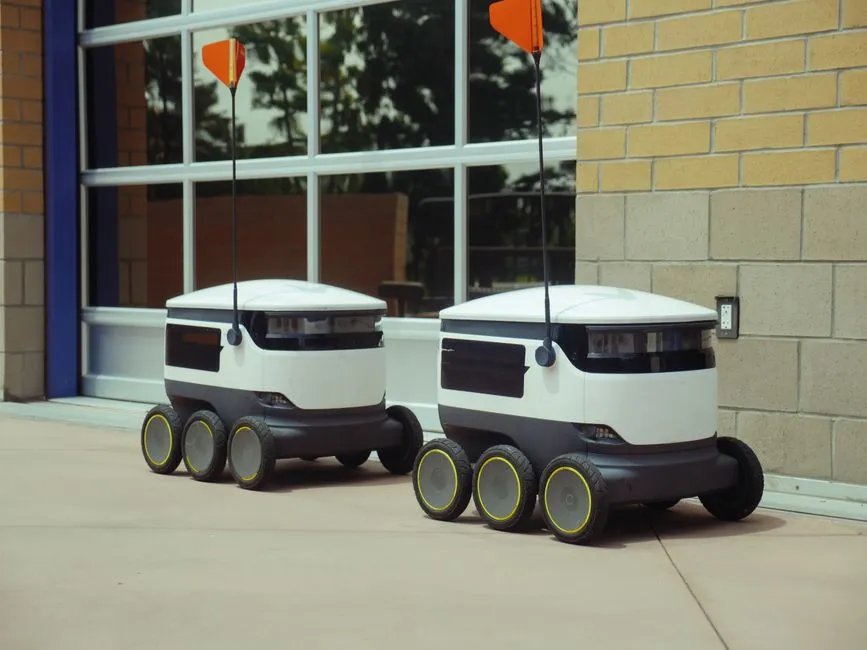
Not all autonomous transportation is about moving people. Some of the fastest-growing applications are happening in logistics. Smart delivery robots are already being used in some cities to carry packages, groceries, and small commercial orders over short distances. These robots may seem small, but they represent a major shift in how last-mile delivery is handled.
Traditional delivery depends heavily on vans, trucks, and human couriers. That model works, but it comes with congestion, labor costs, emissions, and scheduling complexity. Autonomous delivery robots can operate in neighborhoods, on sidewalks, or in controlled pedestrian zones, offering a flexible alternative for short-distance deliveries.
They are also useful in situations where speed and consistency matter. A hospital can move medical supplies between buildings. A campus can transport meals or parcels. A retail chain can reduce delays in final delivery. As these systems become more common, they may start to reshape expectations around delivery speed, cost, and convenience.
The Technologies Behind the Movement
Behind the smooth motion of an autonomous vehicle or delivery robot is a complex stack of technology. Sensors collect raw data, AI models interpret it, and control systems translate that understanding into physical movement. The result is a continuous loop of perception, prediction, and action.
Computer vision helps machines recognize objects and classify them. Machine learning improves accuracy over time as systems encounter more scenarios. Localization allows the vehicle to understand exactly where it is. Planning algorithms determine the safest and most efficient path. Together, these layers create a system that does not simply react to the world, but anticipates what may happen next.
One of the most important parts of this technology is redundancy. In high-stakes environments, a single point of failure can be dangerous. That is why autonomous systems often use multiple sensors and backup computing architectures. If one component is degraded, another can take over. This is a key reason why autonomous transportation remains a long-term engineering challenge rather than a quick product fix.
Safety, Regulation, and Public Trust
The promise of autonomous transportation is large, but the risks are serious too. A malfunctioning system is not just an inconvenience; it can endanger people. That is why safety, regulation, and public trust are central to the industry’s future.
Regulators are beginning to shape rules around testing, deployment, liability, and data privacy. Questions remain about how to classify these vehicles, who is responsible when an accident occurs, and how to ensure that AI systems behave predictably in edge cases. Transparency is also important. If the public does not understand how these systems make decisions, adoption will slow.
Trust is built slowly. It depends on consistent performance, clear communication, and visible accountability. Companies and governments will need to work together to establish standards that protect people without stifling innovation. The goal is not simply to get autonomous vehicles on the road, but to get them there in a way that people accept and rely on.
What the Future of Autonomous Transportation Looks Like
The next decade is likely to be a period of gradual expansion rather than sudden transformation. We may not see driverless cars everywhere immediately, but we will probably see more of them in specific use cases. Autonomous shuttles may become common in certain cities. Delivery robots may expand from pilot programs into regular neighborhood infrastructure. Freight corridors may begin using AI-assisted trucking to improve efficiency and reduce driver shortages.
Over time, these technologies could change the shape of cities. If people do not need to own a car for every trip, parking spaces, road lanes, and even land use may evolve. If delivery networks become more automated, commercial logistics may become faster and less disruptive. If public transit becomes more reliable and affordable, more people may choose shared mobility over private vehicles.
That broader vision is where AI in autonomous transportation becomes more than a technical story. It becomes a story about access, sustainability, and how communities move through their daily lives.
In the end, the rise of AI in autonomous transportation is not just about machines replacing humans behind the wheel. It is about creating smarter, safer, and more flexible systems that can serve people in ways traditional transportation could not. The road ahead will still have obstacles, from technical limits to regulatory questions and public concern. But the direction is clear: artificial intelligence is no longer a speculative idea in transportation. It is becoming a practical force shaping how we move, how cities operate, and how the future of mobility takes shape.
Related read: AI Wonderland Weekly: Why AI Safety Became the Defining Conversation
