


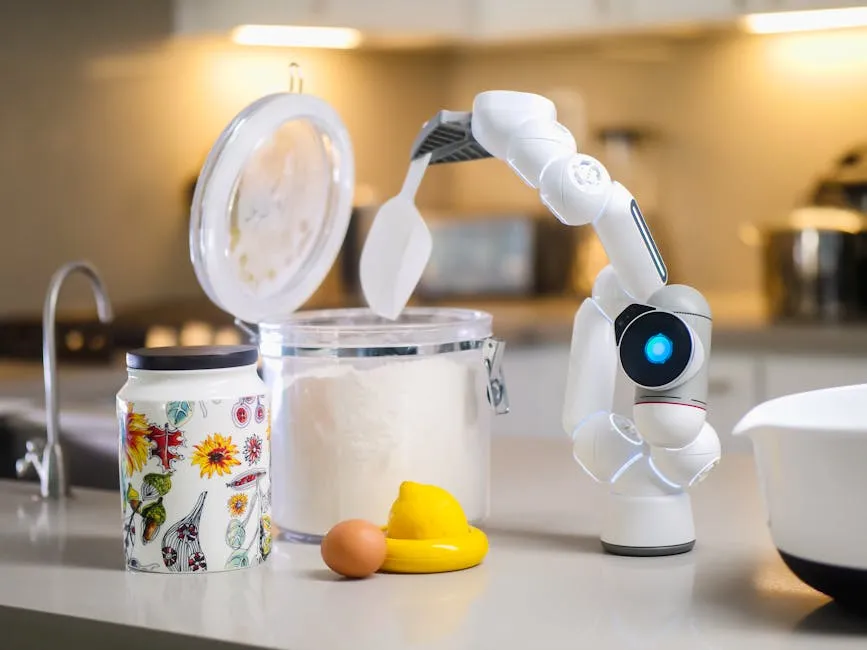
There is a strange intimacy in the mundane. The way you fold a towel, the specific order in which you load a dishwasher, the half-conscious dance you do while sweeping around a chair leg—these are movements you rarely think about. But what if someone, or something, was watching them all, cataloging every flick of the wrist and bend of the knee?
I recently spent a week doing exactly that: recording myself performing everyday household tasks for a company that is training the next generation of humanoid robots. The premise is simple, but the implications are anything but. I signed up to be a data point, a living, breathing training set for a machine that might one day replace the very actions I was performing. It was a week that left me questioning who, exactly, was the robot in this relationship.
The Pitch: Your Chores, Their Future
The concept is straightforward. Several robotics and AI companies are currently in a race to build general-purpose humanoid robots. These aren’t the single-purpose arms you see on an assembly line; they are designed to walk into your home, pick up a sponge, and wash your dishes. But to do that, they need data. Lots of it.
They need to understand the physics of a wet plate, the grip strength required for a ceramic mug versus a plastic cup, and the spatial awareness needed to navigate a cluttered kitchen counter. My week of chores was part of a data collection pipeline designed to teach these machines the “how” of human activity.
The process was surprisingly low-tech. I strapped on a chest-mounted camera and a headset that tracked my eye movement. For seven days, I cooked, cleaned, did laundry, and tidied up while being recorded. Every time I opened a cabinet, every time I folded a shirt, I was feeding a neural network.
The First Few Days: The Uncanny Self-Awareness
The first thing you notice is the self-consciousness. Suddenly, the simple act of chopping an onion becomes a performance. You start wondering if your technique is “correct.” Is there a more efficient way to load the washing machine? Am I holding the broom wrong?
This hyper-awareness is the first crack in the illusion of normalcy. We think of chores as mindless, automatic tasks. But when you are being recorded for a machine, you realize how much unconscious intelligence goes into them. You adjust your grip when a knife slips. You shift your weight to reach a high shelf. You instinctively know not to put a sharp knife in a sink full of soapy water. These are not simple commands; they are complex, real-time problem-solving sequences that we have mastered through years of trial and error.
By day three, the self-consciousness faded, replaced by a strange sense of partnership. I was no longer just cleaning my apartment; I was teaching. I found myself narrating my actions under my breath. “Now I am soaking the pan because the cheese is stuck,” I would mutter. I was providing the context that the camera couldn’t capture.
The Data Behind the Motion
What I was doing is part of a larger trend in the robotics industry known as “imitation learning.” Traditionally, robots are programmed with explicit instructions for every single movement. This is incredibly brittle. If a cup is an inch to the left of where the robot expects it, it fails. Imitation learning bypasses this by feeding the AI thousands of hours of human demonstration. The AI learns the pattern, the intention, and the physics, rather than a rigid script.
My data—the way I tilt a pan to drain pasta, the way I use my knuckle to push a stubborn button on the microwave—is gold for these systems. It teaches the robot how to handle edge cases and fuzzy logic. It teaches it to be human-like, not just machine-efficient.
But this raises a critical question: what happens when the robot learns the bad habits, too? I have a terrible habit of leaving cabinet doors open while I cook. I also have a specific, inefficient way of folding fitted sheets that would make a hotel housekeeper weep. Is the AI learning my “correct” actions, or is it learning my specific, flawed human quirks?
The Emotional Toll: Who is Training Whom?
By day five, the novelty had worn off, and a deeper unease set in. I was working for free, essentially, to train my own potential replacement. The economic logic of humanoid robots is that they will eventually perform these tasks cheaper and faster than a human. I was literally showing them how to take my job—or at least, the job of a domestic worker or a home health aide.
This is the core tension of the “AI panic” that the source material touches on. We are so eager to solve the “last mile” problem of robotics—the messy, unstructured environment of the home—that we rarely stop to consider the human cost of that data.
There is also a psychological component to being watched. Even though I knew the camera was for a machine, it felt like a judgment. Did the AI think I was being lazy for taking a break? Did it notice I skipped cleaning the baseboards? We are creating machines that will observe our most private, vulnerable moments—the time when we are just being ourselves, not performing for the outside world. What does it mean to have a machine witness that?
The Robot’s Perspective
On the final day, I watched a simulation of a robot attempting to replicate my actions. It was clumsy. It overshot the counter. It dropped a sponge twice. But then, after several attempts, it succeeded. It mimicked my exact motion—the way I flick my wrist to shake excess water off a plate before placing it in the rack.
It was a chillingly beautiful moment. A piece of my physical identity had been extracted, digitized, and given to a metal skeleton. A part of me, my specific way of being in the world, now existed inside a machine.
This is the future we are building. We are not just building tools; we are building mirrors. We are teaching them to move like us, to interact with the world like us. But we are doing so without a clear roadmap for the consequences.
The Bigger Picture: The Cost of Convenience
The promise of a robot that does your chores is intoxicating. Imagine the hours of your life you would get back. Imagine the freedom from drudgery. But as my week of recording showed, that convenience comes with a hidden ledger.
We are trading our privacy for automation. We are trading our specific human knowledge for efficiency. We are creating a world where a machine knows the exact pressure you use to scrub a stain, the exact rhythm of your morning coffee routine.
Companies like the one I worked with argue that this data is anonymized and used solely for training. But data has a way of finding other uses. Once a machine can watch you fold a towel, it can watch you for other reasons. The line between training and surveillance is thinner than we think.
So, Who’s the Robot Now?
At the end of the week, I took the camera off. My apartment was clean. My data was uploaded. I sat on my couch and realized that I had spent the last seven days moving with a new purpose. I was efficient. I was predictable. I was providing consistent output.
In a way, I had become the robot. I had suppressed my chaos, my inefficiency, and my humanity to feed a machine. The irony is not lost on me. We fear that robots will become too human, but the process of training them forces us to become more robotic.
This is the real story of the AI and robotics revolution. It is not just about the machines learning; it is about us changing. The future of household chores is not just about having a robot in your kitchen. It is about understanding the value of the messy, inefficient, human moments that the robot is trying to replicate. And it is about deciding if we are willing to lose a little bit of our own humanity to gain a little bit of convenience.
I’m still not sure if I made the right choice. But I do know that the next time I load a dishwasher, I’ll be thinking about what I’m really teaching the world.
