


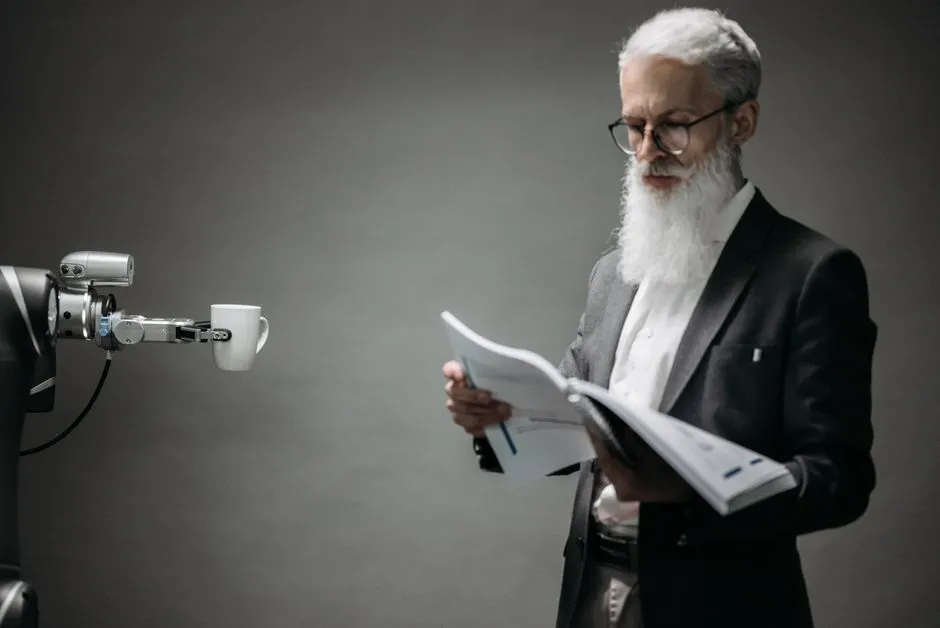
There is a strange new habit forming around artificial intelligence: we keep talking as if the human mind were just another part of the machine. We imagine ourselves as operators sitting in front of a glowing console, feeding prompts into a system, waiting for outputs, and moving on to the next task as fast as possible.
In that image, thinking becomes traffic. Ideas become packets. Questions become inputs. And speed becomes the most important metric of all.
But that image is misleading. Your brain is not a prompt queue. It is not designed to run on continuous, high-throughput input and output cycles. And the fact that AI can generate text, code, images, summaries, or plans in seconds does not automatically make you faster, clearer, or better at thinking.
The Temptation to Turn Thinking Into Prompt Traffic
Modern AI tools are fast. That is part of their appeal. A writer can ask for ten product titles in seconds. A developer can generate a draft function in a few keystrokes. A marketer can get a full campaign outline before the coffee cools. It feels like the old cost of production has disappeared, and with it, the need for slow, deliberate thought.
But when a tool becomes that convenient, it is easy to start treating the problem as one of volume. If the machine can produce a hundred options quickly, the human instinct is to ask for more. The mind, under pressure, starts to resemble a queue: one prompt after another, one output after another, no time to sit with the result.
That is where the metaphor breaks down. A queue can be processed. A person cannot be reduced to processing.
Why Faster AI Does Not Equal a Faster Human
The Bottleneck Is Not the Model, It Is the Mind
The limiting factor in most AI-assisted work is rarely the speed of generation. It is the quality of the request, the clarity of the goal, the ability to judge the output, and the willingness to revise it.
A model can produce a persuasive paragraph quickly, but that does not mean it understands the audience. It can write a plausible business strategy, but it does not carry the context of your company’s culture, your team’s constraints, or your own ethical line. It can summarize a research paper, but it cannot replace the slow act of reading closely enough to notice what is missing.
Human thinking depends on attention, memory, judgment, and often a kind of quiet friction that slows us down in useful ways. We need time to notice when something feels wrong, when a sentence is technically correct but emotionally flat, or when a solution is efficient but misses the point.
Speed Can Reduce Thinking, Not Improve It
Fast output can be seductive because it makes progress feel immediate. But immediate progress is not the same as real understanding. If every idea is answered instantly, the mind may stop doing the work of forming its own position. The result can be a strange kind of cognitive laziness: not because the person is lazy, but because the environment no longer requires the usual pause.
That is why many people feel more overwhelmed after using AI, not less. The tools remove friction, yes, but they also remove some of the natural checkpoints that help us slow down, reflect, and decide.
Without those checkpoints, work can start to feel like scrolling: constant, fast, and strangely unproductive.
What a Healthy Human-AI Workflow Actually Looks Like
If your brain is not a prompt queue, then the goal is not to keep the queue moving. The goal is to use AI as a thinking partner, not as a conveyor belt. That means building in deliberate pauses.
- Start with a clear problem, not just a prompt. Before asking for output, spend time defining what you actually need. A vague prompt usually produces a vague result.
- Let the answer sit for a moment. Do not rush to the next prompt. Read the response, notice what it assumes, and ask yourself whether it matches your intent.
- Use AI to challenge your thinking, not just replace it. Ask it to find gaps, suggest alternatives, or explain the trade-offs. That is where the real value often appears.
- Keep the final judgment human. AI can help you draft, test, and refine, but the decision about what matters should still come from you.
- Protect time for slow work. Some ideas need silence, repetition, or boredom. Not every problem is a speed problem.
From Prompt Queue to Thinking Partner
The mistake is not using faster AI. The mistake is assuming that because the machine is fast, the human should become fast in the same way.
AI can expand the range of possibilities quickly. It can make it easier to test language, structure, and logic. It can help you see what you did not notice. But it does not eliminate the need for taste, context, or judgment.
In other words, the better use of AI may not be to generate more, but to think better.
That means treating the tool as a mirror for your own reasoning, not as an endless stream of answers. It means asking what you are trying to understand, not just what you are trying to produce. And it means remembering that the most important bottleneck in the workflow is not the model. It is the person deciding what the output means.
Final Thought
Faster AI changes the cost of producing ideas, but it does not change the cost of understanding them. Your brain is not a prompt queue, and it should not be used like one.
If you want to work well with AI, the question is not how fast you can make it respond. The bigger question is whether you are still thinking clearly enough to know what to do with the answer.
Related read: When AI Becomes Embodied: What Robots Mean for the Future of Intelligence
