


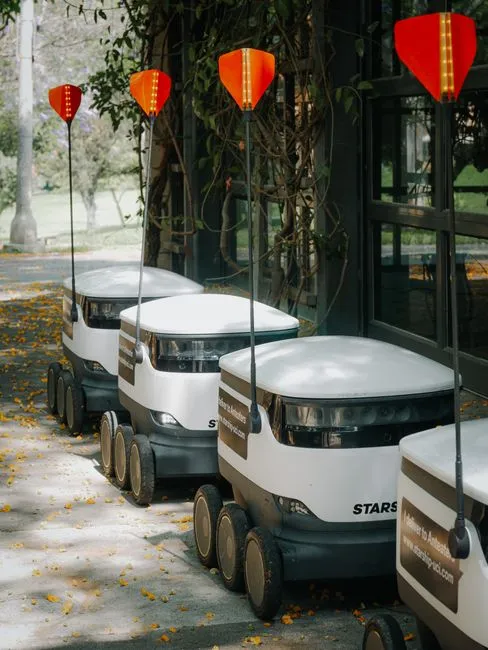
Imagine a city where buses move smoothly through traffic without a driver, where delivery robots glide along sidewalks with careful precision, and where cars can respond to road conditions in milliseconds. This is no longer a sci-fi fantasy. It is the direction artificial intelligence is pushing transportation. As autonomous systems become more advanced, AI is quietly reshaping how people move, how goods are delivered, and how transportation networks operate.
Why AI Is Essential for Autonomous Transportation
Autonomous transportation is not just about removing a human from the driver’s seat. It is about creating systems that can perceive, understand, predict, and act in complex environments. That is where artificial intelligence becomes the core engine.
Unlike traditional software, which follows fixed rules, AI can adapt. A self-driving vehicle, for example, must constantly interpret the world around it. It needs to recognize pedestrians, cyclists, traffic signals, lane markings, construction zones, and even sudden changes in weather. Machine learning models help these systems process vast amounts of sensor data and make split-second decisions.
In many ways, AI gives autonomous transportation the ability to learn from experience. The more data a system processes, the better it becomes at handling edge cases, reducing risk, and improving reliability.
Driverless Cars and the Road Ahead
Driverless cars are probably the most visible example of AI in transportation. These vehicles rely on a combination of cameras, radar, lidar, and high-definition maps to navigate. AI algorithms analyze this information in real time to determine the safest path forward.
However, the challenge is not just driving on open highways. The real test comes in dense urban areas, where conditions change rapidly. A car must anticipate a child stepping into the street, a delivery truck pulling out from a parking spot, or a cyclist making an unexpected turn. These are situations where pattern recognition and predictive modeling become critical.
As AI models improve, driverless vehicles are becoming more capable of handling unpredictable scenarios. This is one reason why autonomous cars are moving from controlled test environments toward broader public use. Still, widespread adoption will require stronger safety standards, clearer regulations, and public confidence.
Autonomous Buses and Shared Mobility
While cars get most of the attention, autonomous buses may have an equally important role to play. In many cities, public transit is the backbone of daily commuting. Adding AI-powered buses can improve efficiency, reduce labor shortages, and increase service frequency.
Self-driving shuttles and small autonomous buses are already operating in limited routes, such as university campuses, business parks, and planned transit zones. These vehicles often follow fixed paths, which makes them easier to manage than fully free-roaming cars. Over time, though, AI could enable more flexible routing, allowing buses to adjust to demand, traffic patterns, and time of day.
This kind of smart public transportation could make cities more accessible and reduce congestion. Instead of relying only on private vehicles, people may increasingly use on-demand autonomous transit services that adapt to their needs.
Smart Delivery Robots and the Future of Last-Mile Logistics
One of the fastest-growing applications of autonomous AI transportation is last-mile delivery. E-commerce has exploded in recent years, and with it, the pressure to deliver goods quickly and affordably has grown. That is where sidewalk delivery robots and autonomous delivery vehicles come in.
These robots may look simple, but they require sophisticated AI. They must navigate sidewalks, avoid pedestrians, climb small slopes, recognize obstacles, and follow precise routes. They also need to communicate with customers, confirm delivery, and handle unexpected situations without human intervention.
Because delivery robots usually operate in lower-speed, more predictable environments, they are often easier to deploy than full self-driving cars. For that reason, they are becoming one of the earliest examples of autonomous transportation that people may interact with regularly.
The Role of Data, Sensors, and Edge Intelligence
Behind every autonomous transportation system is a powerful data ecosystem. Cameras, radar, lidar, and GPS devices collect continuous streams of information. AI models then turn that raw data into meaningful decisions.
One major advantage of modern AI is its ability to operate at the edge, meaning directly on the vehicle or device itself. This reduces latency, which is critical when a decision must be made in a fraction of a second. At the same time, cloud-based systems can analyze larger datasets, update software, and improve models over time.
This hybrid approach is what makes autonomous transportation more resilient. Vehicles can respond immediately to local conditions, while broader network intelligence helps optimize routes, predict maintenance needs, and improve performance across entire fleets.
Safety, Regulation, and Public Trust
For autonomous transportation to succeed, safety cannot be an afterthought. AI systems must be tested rigorously, monitored continuously, and designed with fail-safes in place. Even highly accurate systems can encounter rare situations that are difficult to predict.
Regulators, manufacturers, and city planners all have roles to play. Clear rules around liability, data privacy, cybersecurity, and operational boundaries will be essential. Public trust will also depend on transparency. If people understand how these systems work and see measurable safety improvements, adoption becomes much more likely.
This is why many autonomous transportation projects start in controlled environments before expanding. Gradual rollout allows developers to refine systems, collect real-world data, and build confidence over time.
What the Future Looks Like
The future of transportation will not be fully autonomous overnight. Instead, it will evolve in stages. Some roads will support mixed traffic, where human-driven and AI-driven vehicles share the same space. Some cities will deploy autonomous shuttles first, while others focus on delivery robots or freight corridors.
What is clear is that AI is becoming a foundational layer of modern mobility. It is not just improving how vehicles drive; it is changing how transportation networks are designed, managed, and experienced. From reducing emissions to increasing accessibility, autonomous AI systems have the potential to make transportation safer, cleaner, and more efficient.
In the end, the goal is not simply to replace humans with machines. It is to create transportation systems that are smarter, more responsive, and better able to serve people. As AI continues to mature, autonomous transportation is moving from a futuristic concept toward a practical reality.
Related read: AI’s Turning Point: Why Safety Became the Main Story This Week
