


Autonomous transportation has moved from science fiction into real-world testing, city pilots, and early commercial deployments. At the center of this shift is artificial intelligence, which helps vehicles sense their environment, make decisions, and adapt to unpredictable conditions in ways that would be impossible for traditional automation alone. From driverless cars and buses to sidewalk delivery robots and smart logistics networks, AI is becoming the core engine behind a new era of mobility.
The Core Role of AI in Autonomous Transportation
Autonomous vehicles do not simply follow pre-programmed paths. They must process massive amounts of data in real time, identify objects, predict behavior, and respond to changing road conditions. That is where AI becomes essential. Machine learning models help vehicles interpret data from cameras, lidar, radar, and other sensors. These systems can distinguish between a pedestrian, a cyclist, a parked car, or a piece of debris on the road, then determine the safest course of action.
The value of AI in transportation is not limited to self-driving cars. It also supports route optimization, traffic prediction, fleet management, and infrastructure coordination. In other words, autonomous transportation is not just about the vehicle itself. It is about creating an intelligent ecosystem where vehicles, roads, and services work together more efficiently.
Driverless Cars: The Most Visible Example
Driverless cars have captured the public imagination for a simple reason: they represent a direct replacement for human driving. The promise is clear. If AI can drive safely, it could reduce accidents, lower transportation costs, and make mobility more accessible to people who cannot drive.
However, building a truly autonomous car is remarkably difficult. Driving requires constant judgment, not just perception. A vehicle must understand not only what is happening now, but what is likely to happen next. Will the pedestrian step into the road? Will the car ahead brake suddenly? Should the vehicle change lanes, slow down, or wait? AI systems use deep learning, computer vision, and predictive modeling to handle these decisions at a scale and speed that humans cannot match.
Even so, driverless cars still face major challenges. Weather, construction zones, unusual road markings, and unpredictable human behavior can all complicate autonomous driving. This is why many companies are focused on improving reliability, safety testing, and edge-case handling rather than simply expanding geographic coverage.
Autonomous Buses and Public Transit: A Practical Path Forward
While personal driverless cars often get the most attention, autonomous buses may be one of the most practical near-term applications. Unlike cars, buses typically operate on fixed routes, which makes the environment easier to manage. They can also be deployed in controlled settings such as campuses, transit corridors, and city districts.
For public transit systems, AI-powered buses could help address labor shortages, improve service frequency, and reduce operating costs. A city could run more frequent routes without requiring the same number of drivers, especially during late-night or off-peak hours. Over time, this could make public transportation more reliable, affordable, and attractive to riders.
There is also a broader infrastructure angle. Smart buses can communicate with traffic signals, share data with other vehicles, and adjust schedules based on real-time demand. In that sense, autonomous transit is not just a vehicle technology. It is a city-level system that can reshape how people move through urban spaces.
Smart Delivery Robots and the Last-Mile Revolution
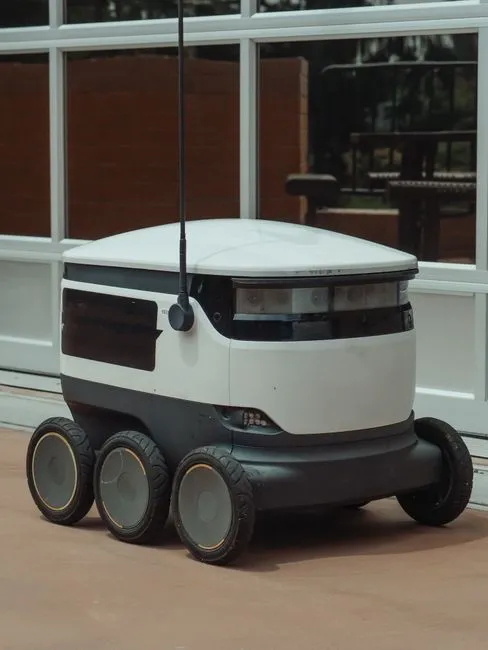
One of the fastest-growing areas of autonomous transportation is last-mile delivery. Smart delivery robots are already being tested in neighborhoods, business parks, and university campuses. These compact, low-speed vehicles use AI to navigate sidewalks, avoid obstacles, and deliver packages with minimal human intervention.
The appeal is economic as much as technological. Delivery is expensive, labor-intensive, and often inefficient. A small autonomous robot can reduce the cost of short-distance deliveries, cut emissions, and improve convenience for consumers. For retailers, logistics companies, and food platforms, that can mean faster turnaround times and lower operational costs.
Delivery robots also benefit from constrained environments. Compared with a fully autonomous car on a busy highway, a sidewalk robot operates in a simpler, lower-speed setting. That does not make the task easy, but it does make it more manageable for early commercial deployment.
The Bigger Picture: AI Across the Transportation Stack
It is easy to focus on the vehicle, but AI is transforming transportation at every layer of the stack. Fleet operators use AI to monitor vehicle health, predict maintenance needs, and optimize charging or fueling schedules. Logistics companies use it to plan routes, reduce idle time, and improve delivery accuracy. Cities use it to model traffic flow, manage congestion, and improve safety.
This broader application is important because autonomous transportation will not succeed in isolation. A self-driving car is only as effective as the system around it. That includes road design, signal timing, data sharing, cybersecurity, and regulation. AI can help improve all of these areas, but it also raises new questions about liability, privacy, and public trust.
Why Trust and Safety Matter
Public acceptance will be one of the biggest determinants of success. People are more willing to adopt new transportation technologies when they believe those technologies are safe, reliable, and transparent. That means companies and governments will need to invest heavily in safety validation, incident reporting, and clear standards for autonomous systems.
Regulation will also play a major role. Different regions are approaching autonomous transportation at different speeds, and the rules will shape how quickly these technologies can scale. In some cases, regulation may lag behind innovation. In others, it may help build the confidence needed for broader adoption.
What the Future Looks Like
The next decade is likely to be defined not by a single breakthrough, but by steady, practical progress. We may not see fully autonomous personal cars everywhere overnight, but we can expect more autonomous shuttles, delivery robots, freight operations, and smart transit services to appear in real-world settings. Over time, these systems will improve as sensors get better, data grows, and AI models become more reliable.
What is clear is that AI is no longer just a feature in transportation. It is becoming the foundation. Whether the goal is safer roads, faster deliveries, lower costs, or more accessible mobility, artificial intelligence is helping turn autonomous transportation from a bold idea into a scalable reality.
In the end, the future of transportation will not be defined by a single machine or a single company. It will be shaped by how well AI can integrate with infrastructure, services, and human expectations. The vehicles of the future may drive themselves, but their success will depend on how intelligently they work within the broader systems we rely on every day.
Related read: 4 Rabbit Holes Exploring How the Computer Is Changing Shape
