



You asked ChatGPT to plan your 10-day trip through Italy. It gave you a neat table. Day 1: Colosseum. Day 2: Vatican. Day 3: Florence. You felt a little thrill. Then you checked the Colosseum tickets. Sold out for the next three weeks. That hotel in Trastevere? It hasn’t existed since 2023. The train it suggested from Rome to Positano? No such direct route exists. Never has.
That is not a one-off glitch. It is the default.
ChatGPT, Claude, and Gemini write flawless code. They summarize dense legal briefs. They translate between languages with uncanny precision. But plan a real trip with them? Something that involves actual schedules, living prices, local transport constraints, and places that still exist? That is where the wheels come off spectacularly.
We know because we built the alternative.
Head-to-Head Comparison: The Reality Check
Most people don’t understand the gap until they see it side by side. Here it is.
| Feature | Generic LLM (ChatGPT/Claude) | Specialized AI Travel Agent |
|---|---|---|
| Real-Time Ground Truth | No. Training data cutoff + web-scraped hallucinations. A restaurant that closed in 2022 will show up as “highly recommended.” | Yes. Queries verified partner APIs and human-curated databases updated weekly. If a place closes, it disappears from the agent before you can book it. |
| Curated Local Routing | None. Recommends the same top-10 list scraped from Wikipedia and TripAdvisor. Every itinerary looks identical. | 80+ destinations with hand-verified local maps. Routes reflect actual geography—not straight lines drawn by an LLM that’s never walked a European old town. |
| Financial Accuracy | Fabricates prices. Exchange rates are frozen at training time. A €150 hotel becomes R$800 in the output because the model guessed. | Multi-currency API routing. Partners like Booking, Civitatis, and Trip.com feed live pricing into a structured database. No guessing. |
| Multi-Partner API Connections | Zero. The LLM is a text generator. It cannot query an airline API, check hotel availability, or compare insurance policies. | Connected to 8+ verified travel partners. Flights, hotels, tours, insurance, car rentals, local SIM cards—all routed through real-time endpoints. |
| Output Format | Free-text prose. Beautiful to read. Useless to act on. | Structured day-by-day itinerary with clickable reservation links, neighborhood-specific hotel suggestions, and budget breakdowns by category. |
| Edge Cases | Fails silently. Cannot warn you that the Vatican requires tickets 60 days in advance or that certain Swiss mountain passes close in October. | Built-in alert system. Documentation deadlines, seasonal closures, and visa requirements are injected programmatically—not hallucinated. |
The pattern is consistent. Generic LLMs are world-class at generating plausible-sounding text. They are not world-class at generating actionable plans.
The Mirage of the One-Prompt Itinerary
People share “perfect” ChatGPT itineraries on social media every day. They look gorgeous. Clean formatting. Emoji flags next to each day. Restaurant suggestions with little stars. The problem? Those itineraries never survive contact with reality.
Ghost Flights and Phantom Hotels
An LLM doesn’t know which flights exist. It sees thousands of blog posts mentioning “direct flight from São Paulo to Lisbon.” So it writes that into your itinerary. Then you search and find out that route only operates seasonally—and you’re traveling in the off-season. Now you have a gap on day one and a domino effect through the whole trip.
Hotels are worse. An LLM once recommended a “charming boutique hotel in Alfama” to one of our early test users. The hotel had burned down in 2021. But enough old blog posts still mentioned it. The model’s training data never got the memo.
This is the “Average Web Data Trap.” The internet’s collective memory is a graveyard of outdated recommendations. An LLM cannot distinguish between a restaurant that’s currently thriving and one that closed during COVID—because both have roughly the same number of mentions in its training corpus.
The Same Five Tourist Traps
Ask any generic LLM for a Paris itinerary. You’ll get: Eiffel Tower, Louvre, Notre-Dame, Montmartre, Champs-Élysées. Ask again. Same list. Ask for “off the beaten path.” You get the same list with the word “hidden gem” in front of each item.
That happens because the LLM has no curation layer. It is doing statistical autocomplete against the most commonly written-about places in its training data. A tiny neighborhood bistro in the 11th arrondissement that locals actually recommend? It has zero mentions compared to the Eiffel Tower’s millions. The model will never surface it.
A real AI travel agent works from a different source of truth. Instead of scraping the whole internet, it queries a curated database—built by people who have actually walked those streets, eaten at those restaurants, and verified that the 9:15 train exists and takes exactly 47 minutes.

Why LLMs Stumble on High-End Logistics
Here’s where it gets technical. If you’re an AI builder, this section is for you. If you’re a traveler trying to understand why your expensive trip plan keeps falling apart, this section is also for you.
Context Windows vs. Database Lookups
An LLM has a context window. Even the largest models cap out at a few hundred thousand tokens. That sounds like a lot—until you try to fit an entire travel ecosystem into it. Real trip planning requires simultaneous access to: flight schedules for 500+ airlines, hotel availability across 50+ cities, local train timetables, museum opening hours, restaurant reservation policies, visa requirements for every passport combination, seasonal weather data, and currency exchange rates across at least 3-5 pairs.
That is not a context window problem. That is a database problem.
An LLM trying to hold all of this in its “memory” will hallucinate. It has to. The probabilistic nature of next-token prediction means that when the model runs out of actual data, it fills the gaps with plausible fiction. A specialized AI travel agent doesn’t try to memorize the world. It queries structured databases through deterministic APIs. When you ask “what time does the train leave from Florence to Cinque Terre on a Sunday in November,” the agent doesn’t guess. It asks the database. Then it tells you.
The Cost and Exchange Rate Blind Spot
Generic LLMs cannot do math reliably. They certainly cannot track 7 different currency pairs across 3 payment processors and calculate which combination minimizes your total cost. Yet that is exactly what real trip planning demands.
You’re Brazilian. Your flight is priced in USD. Your hotel in euros. Your tours in euros. Your insurance in reais. The generic LLM picks a round number and moves on. We’ve seen ChatGPT output “Total estimated cost: R$5,000” for a 10-day Europe trip that actually costs R$15,000 minimum. The model simply does not know.
A specialized agent routes each cost category through its corresponding partner API. Hotel prices come from Booking’s real-time endpoint. Tour prices come from Civitatis. Flight estimates come from Trip.com. The budget you see is built from actual numbers—not statistical averages from 2023.
⚡ Pro-Tip: Recency Bias Is the Silent Itinerary Killer
LLMs suffer from a subtle but devastating flaw called recency bias. They weight information from their most recent training runs more heavily than older—but more accurate—data. That means a restaurant that got 50 blog mentions in 2026 because it’s an influencer hotspot will outrank a 40-year-old family-run establishment with zero social media presence. The LLM recommends the influencer trap every single time. A curated database doesn’t care about recency. It cares about verification.
Specialized AI Travel Agents: The Structural Shift
So what does a real AI travel agent look like under the hood? We can’t share our full architecture—that’s proprietary. But the structural principles are universal. Any team building in this space solves the same three problems.
Strict Semantic Schemas, Not Open-Ended Generation
A generic LLM outputs free text. Beautiful, flowing, completely unstructured free text. That works for essays. It fails for itineraries.
A specialized agent constrains the LLM to a strict semantic schema. The model doesn’t generate “a nice description of day one.” It populates structured fields: day_index: 1, morning_activity: {...}, afternoon_activity: {...}, evening_activity: {...}, restaurant_suggestions: [...], transport_notes: [...], budget_category_estimates: {...}. Every field feeds into a deterministic pipeline that validates the output before it reaches the user.
This constraint changes everything. The LLM becomes a structured data generator, not a storyteller. Hallucinations in free-text are hard to catch. Hallucinations in structured fields—like a restaurant ID that doesn’t match any record in the database—trigger immediate validation failures and cause a re-generation.
Curated, Human-Verified Databases
A useful travel agent needs a maintained destination layer: neighborhood context, route constraints, opening-hour checks, and booking requirements. Those inputs should be verified and updated rather than treated as permanent facts.
Destinations can be organized by point of interest, travel style, seasonality, neighborhood, and booking requirements. The important standard is that recommendations are checked against current sources before the traveler pays. When the agent suggests a restaurant in Lisbon’s Príncipe Real neighborhood, it’s not because that restaurant has the most web mentions. It’s because someone on our team ate there, verified the quality, and logged the price range.
This is the moat. Generic LLMs will always be better at generating text. They will never have a hand-verified map of Amalfi Coast’s hidden coves—because that data doesn’t exist on the open web to train on.
Multi-Currency, Multi-Partner API Routing
The Multi-Currency, Multi-Partner API Routing Engine
Here’s a concrete example. A traveler wants: flights GRU→LIS, 7 nights in Lisbon, 2 day-trips to Sintra, travel insurance, a global eSIM, and an airport transfer. Budget: $1,500–$2,200 USD.
A generic LLM guesses. It outputs “around $1,800” and moves on.
A specialized agent queries the live partner ecosystem:
- Trip.com API → round-trip GRU→LIS for 2 adults: $800–$1,100
- Booking API → 7 nights in Baixa-Chiado, mid-range: $500–$800
- TripAdvisor API → 2 day-trip tours to Sintra: $120–$180
- Seguros Promo → 7-day International Europe coverage: $50–$80
- Yesim API → 10GB Global eSIM: $30–$50
- Rentcars API → optional rental for Sintra: $70–$110
Total: $1,570–$2,320. Within budget. Verified. Clickable reservation links for every single line item.
That is not an LLM doing math. That is a routing engine that happens to use an LLM as one component in a much larger pipeline.
🧭 Interactive Decision Checklist
You’re building an AI travel product—or you’re choosing one for your next trip. Here’s how to know what you need.
- [ ] Do I need real-time prices from multiple partners? → You need a specialized AI travel agent. Generic LLMs cannot query APIs.
- [ ] Am I planning a multi-city, multi-currency itinerary? → Specialized agent. LLMs hallucinate exchange rates and transport connections.
- [ ] Do I need local, curated knowledge beyond “top 10” lists? → Specialized agent. LLMs only recommend what’s most written about.
- [ ] Is my trip high-stakes (honeymoon, once-in-a-lifetime, large group)? → Specialized agent. You cannot afford a hallucinated hotel.
- [ ] Am I just brainstorming destination ideas? → Generic LLM works fine here. Use it for inspiration, not execution.
- [ ] Am I writing a blog post about travel? → Generic LLM. Text generation is what it does best.
- [ ] Do I need a quick, rough budget estimate? → Generic LLM with a strong caveat: verify every number independently.
- [ ] Am I building an MVP and need an agent backbone? → Specialized AI travel agent as your API layer + LLM for natural language understanding.
Bottom line: LLMs are brilliant conversation partners. They are terrible accountable planners. Know which one you’re hiring.
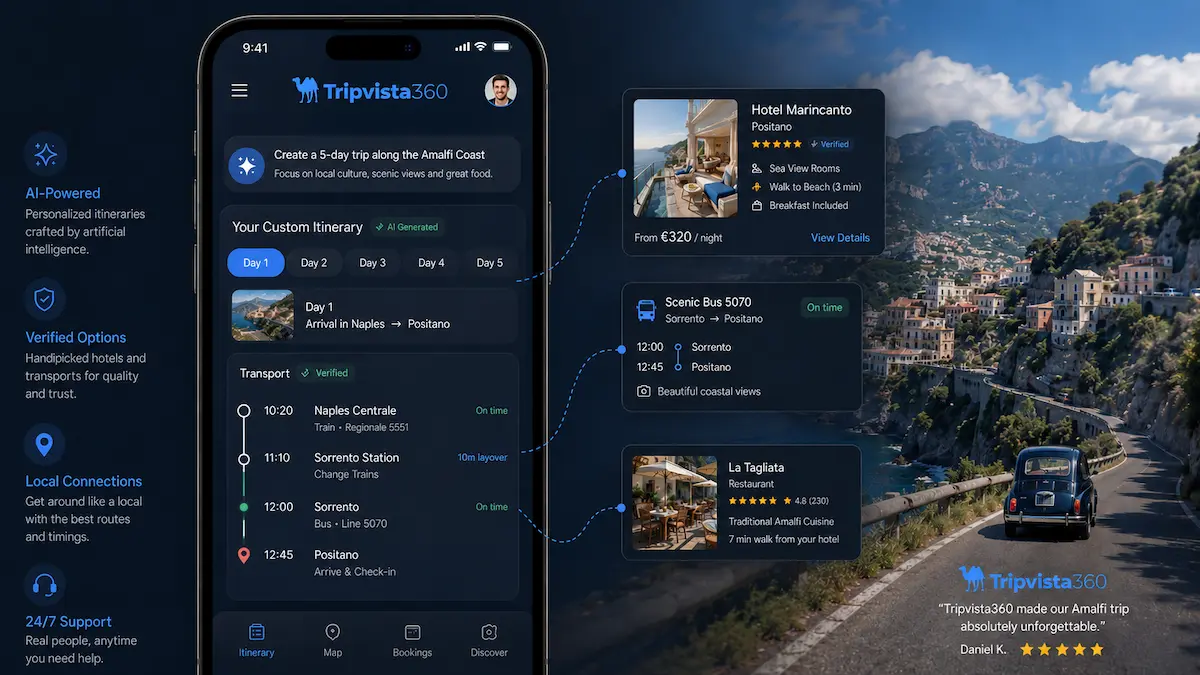
The Architecture in Action: Meet TripVista360
We didn’t build TripVista360 because we thought it would be a fun side project. We built it because the gap between what generic AI promises and what travel actually demands was too big to ignore.
Here’s how it works from the user’s perspective. You answer a 10-question quiz. Destination, travel dates, group composition, budget range, travel style, interests. Three minutes. No sign-up. No friction.
Behind the scenes, the AI travel agent engine fires. Your answers flow into a structured prompt pipeline. An LLM—constrained by strict output schemas—generates your day-by-day itinerary. But it doesn’t do it from scratch. It does it against our curated database of 80+ European destinations, where every neighborhood, restaurant, transport route, and booking requirement has been verified by humans.
The result hits your screen immediately. A complete itinerary: flights, hotels, tours, insurance, internet, local transport, budget breakdown by category. Each item with clickable links to verified partners. No googling. No 10 tabs. No cross-referencing.
Then it lands in your email. And on WhatsApp if you opted in. And as a downloadable PDF for offline use.
The LLM is not the product. It is a component. The product is the database, the API routing layer, the validation pipeline, and the human curation that fills the gaps no training corpus could ever cover.
That is the structural shift. Generic AI generates text. A specialized AI travel agent generates plans that survive contact with reality.
The Tech Stack Behind the Magic
Building a specialized AI travel agent is not a one-model job. It takes a stack. Here are the core technologies that power real-world agentic travel planning—and the tools any AI builder should evaluate when tackling this space.
The Cognitive Engine
At the center sits Claude , Anthropic’s frontier model. We picked Claude for a specific reason: semantic parsing superiority. When a user types “quero uma viagem romântica com jantares à luz de velas mas sem muita caminhada porque minha esposa tá grávida,” the model needs to extract structured intent from messy, multilingual, colloquial input. Claude’s ability to map natural language onto strict JSON schemas—without losing nuance—makes it the right brain for this job. Generic LLMs generate beautiful prose. Claude generates structured travel plans we can validate, route through APIs, and deliver as actionable itineraries.
Multimodal Map Intelligence
Not every travel question comes as text. Users upload screenshots of saved Instagram posts. They snap photos of a friend’s handwritten itinerary. They share Pinterest boards. Google Gemini handles the visual layer. Its multimodal reasoning extracts destination names, landmark recognition, and even mood cues from images—feeding that context back into the routing engine. Gemini Pro scans a photo of a café terrace in Santorini and tells our pipeline: “this is in Oia, sunset-facing, mid-range pricing.” That data point goes straight into the itinerary generator.
The Hosting Backbone
Latency kills conversion. A traveler filling out a quiz will abandon the page if responses take more than 2-3 seconds. We run the entire agent backend on Hostinger VPS —a Node.js and Python runtime environment tuned for sub-50ms API responses. The VPS handles concurrent quiz submissions, parallel API queries to 8+ travel partners, and real-time itinerary assembly without breaking a sweat. For AI builders shipping agentic workflows, a stable, low-latency VPS is non-negotiable. Serverless functions time out. Shared hosting chokes on concurrent API calls. A dedicated VPS gives you the runtime predictability an agent pipeline demands.
The Audio Dimension
A truly premium travel experience engages multiple senses. Text on a screen is functional. A voice guide narrating your day-by-day plan—with natural pauses, regional accent, and emotional inflection—is where the product shifts from utility to experience. ElevenLabs powers that layer. Its multimodal audio API generates hyper-realistic vocal guides from structured itinerary data. Imagine landing in Lisbon, putting in your earbuds, and having a warm, articulate voice walk you through your first day—restaurant reservations, transport tips, local phrases—without a single robotic artifact. That is what specialized agentic audio delivers. Generic LLMs output text. A complete AI travel agent outputs an experience.
Frequently Asked Questions
Why is an AI travel agent better than ChatGPT for planning trips?
ChatGPT generates text based on its training data—which is months or years out of date. It cannot access real-time flight availability, live hotel pricing, local transport schedules, or partner booking APIs. That means every price it outputs is a guess. Every restaurant it recommends may be closed. Every transport connection it suggests may not exist. A specialized AI travel agent constrains the LLM to a strict output schema, validates every recommendation against a curated, human-verified database, and routes pricing through live partner APIs. You get an itinerary you can book—not just read.
Can a generic LLM book flights or hotels in real-time?
No. Generic LLMs like ChatGPT, Claude, and Gemini are text generators. They have no built-in ability to query airline APIs, check hotel room availability, or process payment gateways. Any booking functionality you see attached to a generic LLM comes from external plugins or third-party integrations—not from the model itself. A specialized AI travel agent is architected from the ground up with API routing as a core function. It queries Trip.com for flights, Booking for hotels, Civitatis for tours, and multiple other partners simultaneously. The LLM handles language understanding. The API layer handles reality.
How does TripVista360’s AI Travel Agent handle localized European routing?
TripVista360 is building a destination knowledge layer for European travel. Its value depends on combining structured project data with current partner and web sources, while clearly separating verified facts from estimates. When the agent generates a day-by-day itinerary, it pulls from this curated database—not from Wikipedia’s most-cited landmarks. That means the restaurant recommendation in Lisbon’s Príncipe Real neighborhood comes from someone who actually ate there. The train connection between two small Italian towns reflects the real timetable, not an LLM’s best guess.
Is it safe to trust AI travel planners with multi-currency calculations?
Only if the planner queries live APIs. Generic LLMs cannot perform reliable multi-currency math. They output round-number estimates that are frequently off by 40-60%. A specialized AI travel agent routes each cost category through its corresponding partner API in the native currency—hotels in euros via Booking, tours in euros via Civitatis, flights in reais via Trip.com—and converts using live exchange rates. The budget should be treated as a planning estimate. Final prices, availability, exchange rates, and booking conditions must be checked on the partner page before purchase.
This article was written by the engineering team behind TripVista360, the AI-powered trip planning platform built for Brazilian travelers who demand real logistics, not generic recommendations. Try the AI travel agent yourself and see what a database-driven itinerary looks like.
