


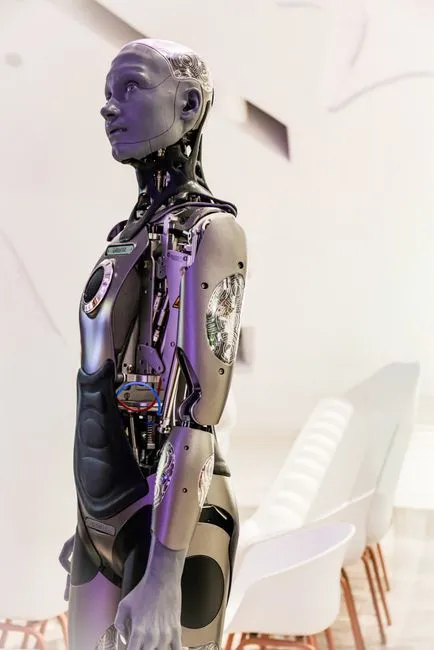
The race to build the perfect humanoid robot is heating up, and the latest contender is a fascinating hybrid. Imagine a machine that stands six feet tall, built like a heavyweight athlete, combining the robust hardware of a Chinese robotics leader with the sophisticated artificial intelligence brain of an American tech giant. This is not science fiction; it’s the H2+, a new humanoid robot that embodies a unique global collaboration.
At the recent GTC conference, Nvidia’s robotics lead, Spencer Huang, unveiled this ambitious project to WIRED, describing it as a machine that truly “combines the best of both worlds.” The robot is a physical manifestation of the idea that the future of robotics might not be built by a single company, but through a strategic fusion of specialized strengths.
The Body: A Foundation of Strength from Unitree
The physical form of the H2+ is provided by Unitree, a Chinese robotics company already known for its impressive, agile robots. The H2+ is not a delicate lab experiment. It’s a “beefcake,” a powerful, 6-foot-tall machine with a 30-pound payload capacity. This is a robot designed for real-world work, capable of lifting and manipulating objects in industrial, warehouse, or potentially even home environments.
Unitree’s expertise lies in creating the physical platform: the motors, the joints, the structural frame, and the low-level control systems that allow the robot to walk, run, and maintain balance. This is an incredibly complex engineering challenge, and Unitree has established itself as a leader in providing a reliable, high-performance body for generalist robotics.
The Brain: Nvidia’s AI Powerhouse
This is where the “American brain” comes into play. Nvidia is not just a hardware company. It is the central nervous system for the entire AI industry. The H2+ is powered by Nvidia’s GR00T (Generalist Robot 00 Technology) foundation model. This is the software suite that gives the robot its intelligence, its ability to understand the world, and its capacity to learn new tasks.
Think of it this way: Unitree provides the athlete’s body, the muscles, bones, and reflexes. Nvidia provides the athlete’s brain, the strategic thinking, the ability to interpret a coach’s play, and the skill to learn a new move. The GR00T model allows the H2+ to perceive its environment, follow natural language commands, and perform complex manipulation tasks that go far beyond simple, pre-programmed routines.
Why This Hybrid Approach Matters
This partnership is a powerful statement about the future of robotics. For years, companies have tried to build the entire robot from scratch, a monumental task that requires world-class expertise in both hardware and software. The H2+ demonstrates a more pragmatic and potentially faster path to market.
Accelerated Development: By combining Unitree’s proven hardware with Nvidia’s leading AI, the development cycle is dramatically shortened. Nvidia doesn’t need to build a factory for robot limbs, and Unitree doesn’t need to invent a new AI from the ground up.
Best-in-Class Components: The robot benefits from the absolute best technology each partner can offer. The H2+ is not a compromise. It is a sum of its superior parts.
A Model for the Industry: This collaboration could become a blueprint for the entire robotics industry. We may see a future where “body builders” and “brain makers” specialize, creating an ecosystem of interoperable parts, much like the PC industry.
What Can the H2+ Actually Do?
While still in its early stages, the H2+ is designed for a future where humanoid robots work alongside humans. Its potential applications are vast. Imagine it in a warehouse, picking and packing items with the dexterity of a human worker. Picture it in a factory, handling heavy machinery or performing repetitive assembly tasks. In the long term, robots like this could assist with household chores, care for the elderly, or even respond to disaster situations.
The robot’s strength and AI-powered vision allow it to perform tasks that were previously impossible for machines. It can identify objects, understand spatial relationships, and adapt to changes in its environment on the fly. This is a giant leap from the rigid, pre-programmed industrial robots of the past.
Challenges and the Road Ahead
Despite the impressive technology, significant hurdles remain. The cost of such a sophisticated machine is currently astronomical, putting it out of reach for all but the largest corporations. Battery life, safety in human environments, and the sheer complexity of teaching a robot to handle the infinite variety of the real world are all monumental challenges.
Furthermore, the geopolitical implications of this “Chinese body, American brain” model are significant. It highlights the deep interconnectedness of the global tech supply chain, even in a time of rising trade tensions. It also raises questions about where the final assembly will happen and how export controls might apply to such a hybrid product.
Conclusion: A New Chapter in Robotics
The Nvidia-Unitree H2+ is more than just a new robot. It is a symbol of a new era in robotics. It represents a shift away from the idea of a single, monolithic creator and towards a world of specialized collaboration. By marrying a powerful, athletic body with a world-class AI brain, this “Frankenstein” robot is not a monster, but a potential workhorse for the future. It is a clear signal that the future of humanoid robots will be built not by one company, but by the smartest combination of global talent and technology. The journey from lab to living room is long, but the H2+ is a powerful and exciting step forward.
